Header text

EssayTagger is a web-based tool to help teachers grade essays faster.
But it is not an auto-grader.

This blog will cover EssayTagger's latest feature updates as well as musings on
education, policy, innovation, and preserving teachers' sanity.

Thursday, March 1, 2012

Changing how we think about rubrics

Traditional rubrics are too general and macroscopic to help students. The future is specificity. And it's here.

Sharing rubrics is a simple, but important, way for teachers to collaborate.

Unfortunately, traditional rubrics -- by their nature -- can only address general, overall trends in a paper: "Some evidence was insufficient." That's fine for a quick, high-level diagnostic, but it's not very helpful for the student.

My goal when I'm grading papers is to coach the students so they can learn from their mistakes and do better next time. Traditional rubrics are good for setting expectations before the attempt, but once the essays are graded, they're really just an assessment tool. They're not a learning tool.

In order to improve, students need more fine-grained feedback: Which specific piece of evidence was weak? Why wasn't it compelling?

Traditional rubrics simply can't address these questions (nor, to be fair, were they meant to). Traditional rubrics are macroscopic. But students need the microscopic.

Latest Update: Rubric sharing and rubric import!

Instructions for using our new rubric sharing and rubric import features!


You can -- and should -- share your EssayTagger rubrics with your colleagues and/or the whole world wide web!


Sharing a rubric
After you log in you'll notice the new top nav menu bar:

Here's a bigger view so you can read the options:

Click on "my rubrics" and you'll see the new My Rubrics page:

This page will list all of your rubrics. Pick a rubric you'd like to share and click on the "view / share" link. That will take you to the Sharing Info page for that rubric:

Wednesday, February 22, 2012

Accountability and Incentives: A Cautionary Tale, pt1

Introduction

I understand the rationale behind the push for ever-increasing teacher accountability -- it's natural to want to insure that your kids are getting the quality education they deserve. Teachers can't just sit back and say, "Trust me, I know what I'm doing." Those days are over. Fair enough.

But we teachers need the rest of the country to understand that when we push back against how teacher accountability is being implemented, we are not just scurrying around trying to hide our incompetence or protect our "cushy" jobs.

We can handle the scrutiny. Most of us would be eager to let our students' successes serve as evidence of our effectiveness as educators. I don't think we fear accountability -- if that accountability is implemented properly, if success is defined properly.

It's not about rigging the game in our favor, lowering the bar, or any of that nonsense; it's about making sure that we're judged for the things that really matter, the things that we teachers do that actually improve students' lives.

The American public needs to realize that not all forms of teacher accountability are created equal. Worse, the most popular methods can be misleading or downright detrimental. Even "no-brainer" approaches like rewarding "effective" teachers with bonuses have already ended in failure. Just because greed-maximizing incentives (sort of) work for capitalism doesn't mean they work for education.

However, hearing these arguments and really feeling them are two different things. And somehow teachers have been turned into the enemy -- or at least that's how it feels to us -- to the point where no one seems much interested in listening to the people who have the most expertise on the subject.

But I think the power of satire and absurdity has a chance to get the message across. So, in that vein, I offer you:

Monday, February 20, 2012

Latest Updates: Going global + enhanced security for student info

We are now global! 
Everyone on the planet can now grade essays faster and more efficiently!

Users from anywhere in the world can register on the site and use the free trial to grade a class set of essays (full details on the registration page).


Enhanced security for student information
Part of our to-do list for going global was to make sure that we were doing everything in our power to secure and protect students' personal information. Here are the steps we've taken:

Students' personal information is encrypted in our database using industry-standard best practices to guide our selection of encryption algorithms and encryption strength. If a hacker were to gain access to our records, s/he would only see the encrypted values:

firstName lastName email
BsBzpBQkQIN9s6RwV7fr58G2eY8qn2a6 yNd9sZ056n5xS14Qe5uZd3hefgY3s59i vA8ezh8Vlm3W9WscfkFGQw4C

Each piece of information is individually encrypted in such a way that "cracking the code" for one value does not make it any easier to decrypt the other values.

In fact, EssayTagger's own internal view of the database makes students' information appear just as garbled to us as it would be to an outside hacker.

We have taken these precautions even though it is highly unlikely that our database would be compromised. We are running on Google's computing infrastructure and therefore Google's efforts to safeguard their own computers are our first line of defense. Their computing infrastructure is among the most robust and powerful in the world and any improvement they make to the security of their system automatically protects EssayTagger.com under the same umbrella.

We will never contact a student unless it is an assignment-related notification (e.g. to tell them that their graded essay is available for their review) or if there is a technical issue that requires action on the student's part in order to be resolved.

Note: Instructors can decide whether or not they want the system to collect and store student email addresses. This will allow teachers to remain in compliance if there are any local or national restrictions regarding student contact info.

We will not sell or share students' personal information with any third parties or use students' information for marketing or any purposes outside of what is required to facilitate student-teacher interaction in our system.

Students are not added to any mailing lists.

Friday, January 27, 2012

Open Beta extended and subscription bonus announced!


I have two important EssayTagger.com updates to share:

Open Beta extended
Our free Open Beta feedback period has been extended to February 10th! That gives you and your colleagues a little more time to try us out as much as you like without committing a single dime. After Feb 10th our $10/month pricing will go into effect.

I'm super-grateful for the valuable feedback we've received during this Open Beta period. So many of your questions, comments, and criticisms have really helped to guide my thinking and have already helped EssayTagger evolve.


Subscription bonus
I think you early adopters deserve to be rewarded. It takes courage and patience to dive into new technology that does not yet have a proven track record.

So I'm pleased to announce our Open Beta subscription bonus: Anyone who subscribes to EssayTagger before the end of Open Beta will receive their first month of service for $1.

Specifics:

  • Commit to a subscription anytime before Feb 10th, 11:59pm (CST).
  • Your first month will be $1.
  • You won't be billed until Feb 11th.
  • Subsequent months will be billed at our standard $10/month rate.
  • Anyone is eligible--including new users--as long they commit before the deadline.
  • See the FAQ for info on canceling, summer break, and group licenses.


Help us spread the word!
Now is obviously the time to try us out. Please help us build a spike of interest in these last two weeks of Open Beta!

Tweet a link to this post, blog about it, tell your colleagues and friends.

And keep that feedback coming!

Friday, December 23, 2011

Latest Update: Rubric drill-down analytics

This is one of the features I was most excited about when I first conceived of EssayTagger!

Read on or watch the tutorial video!

When you grade your essays in our system you're tagging and evaluating the students' text and storing it all in our database. That means that we can then retrieve all that information in powerful ways that aren't possible with traditional grading methods.

Grade a class set of papers and then go to the assignment's rubric performance analysis screen.
"analytics" tab > view aggregate rubric results

From here you can now drill down into each individual rubric core element. We're going to jump into the "Topic sentence" core element:

Click any of the "show text excerpts" checkboxes and the site will hit the database and retrieve your data:

The bold text is the feedback comment you selected for the student and the quoted text is the corresponding excerpt from each student's essay! The list is filtered to display, in this case, only the excerpts that were evaluated as being of "Level 4" quality. You can display the associated text excerpts for each quality level.

To make all of this more concrete, let's take a look back at the grading app:
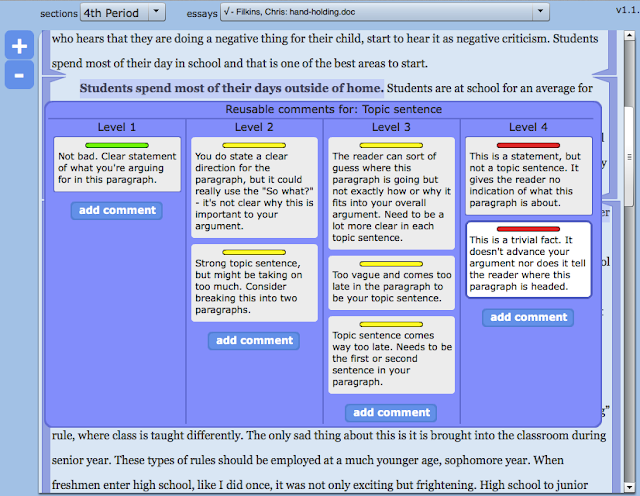

Notice the highlighted essay text just above the comment selection box: "Students spend most of their days outside of home." Since that's a bad topic sentence, I'm going to select a Level 4 feedback comment. I chose the "This is a trivial fact" comment (of course you can always add a new comment if the existing ones aren't sufficient).


And if you look back at the drill-down analytics, you'll see that tagged text excerpt near the bottom of the list:


You can also select the "show students" checkbox to retrieve the name of the student who wrote each excerpt in the list:

Thank you to my friends who allowed me to use their names as sample students!

You can also uncheck "show text excerpts" and just display the student names:


This is a very simple--but very powerful--example of what EssayTagger.com can do now that all of your essay evaluations are in our database. Super-cool stuff!

Next I'll give you some ideas for how to use this data in your classroom.

Thursday, December 15, 2011

Latest Update: Class rosters!

Major new update: we now fully support class rosters in the system!

I've designed it to be as little work as possible for teachers to build and manage their class rosters. Under the ideal scenario (outlined below), you can let the students build the rosters for you automatically when they upload their first assignment.

Here's the tutorial video for creating and managing your class rosters in EssayTagger.com:

The student upload process has also been slightly altered to accomodate the changes. Here's the new version of the tutorial for student uploads:

And you can still upload essays yourself. It isn't ideal, but we know that not everyone is ready to have the students do the uploading. The biggest downside of uploading essays yourself is that it takes a bit more work to then associate each essay with a student. Here's the instructor upload tutorial: